A garage door replacement in a Fairfax County planned community usually needs two separate approvals, and only one of them involves the county. The architectural review comes first, it is enforced by deed restriction rather than by building code, and it can stop a door that is perfectly legal to install.
Fairfax County Land Development Services decides whether the work needs a building permit, and a like-for-like swap in the same opening normally does not. Your association's architectural control committee decides whether the door is acceptable on the lot, and it can say no regardless of what the county allows.
The two answer different questions. The county asks whether the work is safe and lawful. The association asks whether the door belongs on that street.
The standard is harmony: design, materials and color consistent with the house. In practice that produces rules on four things.
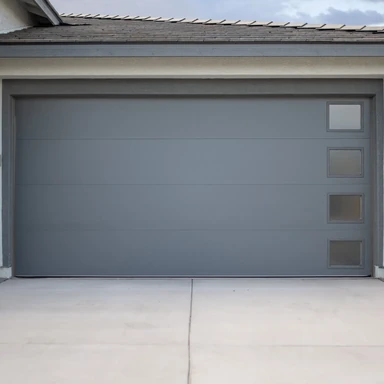
Color is the first, and it is usually tied to the existing palette rather than to a named color. A door that matches the trim but not the siding is often refused, and one that matches nothing in the street is refused faster. Style is the second: raised panel, carriage style, flush, and whether window inserts are allowed above the middle row. Material is the third, and most guidelines allow wood or metal but not every finish within them.
The fourth is door type, and it is where owners get surprised. The published guidelines for Wooded Glen Section I, a Fairfax County association, require an application showing that the design, materials and color of a replacement door are consistent with the house, allow a door of wood or metal, and state that slide-to-side, side-hinged and tilt-up canopy or retractable doors may not be used unless the committee grants an exception. If you have been looking at a carriage door that swings out rather than up, that clause decides the purchase.
Most committees ask for the same short list: a description of the change with dimensions and materials, the manufacturer and model of the door, a color sample with the brand and code rather than a photograph, a drawing or the manufacturer's elevation, and a photograph of the house from the street.
Add the contractor's license and insurance certificate, which several associations require before work starts.
One practical warning from the Wooded Glen document: applications are circulated to neighbors, so do not put cost or financial information in the submission.
The same guidelines ask for applications at least thirty days before the planned start, and state that the committee aims to decide within about seven days of a complete application. Approval then has a completion window: work must be finished within six months unless an extension is requested.
That ordering matters. Doors are made to order and lead times run weeks. If you order on the assumption of approval and the committee asks for a different panel style, you own a door you cannot fit. Get the written approval first, then order.
Fairfax County Land Development Services handles permits. A same-size replacement with no framing or electrical change is normally not a permitted project. Widening or raising the opening, changing the header or load-bearing framing, or adding a new circuit for an opener changes that, and those are permit questions.
The county's own guidance is that permit requirements follow the scope of work, so the safe sequence is to describe the job to Land Development Services before the door is ordered. The number is 703-222-0801. Do not rely on a forum post about a neighbor's job, because the scope is what decides it.
Virginia's Property Owners' Association Act, in Title 55.1, Chapter 18 of the Code of Virginia, sets the framework for associations, their recorded covenants and the disclosure packet a seller must provide. The architectural guidelines you are handed at closing sit inside that structure, and they run with the lot rather than with the owner who signed for them.
That is why the approval follows the house when it sells. A door installed without approval can be required to come out, at the cost of whoever owns the house at the time.
The county's planned communities were built in matched phases, so a street of townhouses often shares one palette and one panel profile. A door two shades off is visible from the end of the row. Associations in the larger ones, from Burke to Kingstowne to the Reston area, commonly maintain a palette and an approval process.
There is a second local pattern. Because so many garages here are used as storage rather than parking, owners often want a taller door or a different track configuration to gain clearance. That request needs both an association exception and a permit conversation, because raising an opening is structural work. Ask about it before you fall in love with a door that will not fit.
Fairfax Garage Doors is a matching service. We do not install doors and we do not sit on anyone's committee. Instead, we make sure the quotes you receive specify a door model, color and hardware clearly enough to put in front of an architectural committee, because a vague quote is the most common reason an application comes back.
You take the quotes, you make the submission, and you hold the contract and the warranty with the company you choose.
If your home is in an association with architectural covenants, yes in most cases. Exterior changes usually need written approval before work starts.
Yes. Most guidelines require the door to be consistent with the house and street, and committees can refuse a color outside the approved palette.
Published guidelines in Fairfax County associations commonly ask for submissions about thirty days before the start date and aim to decide within about a week.
A same-size swap normally does not. Widening the opening, changing framing, or adding electrical work for an opener does. Confirm with Fairfax County Land Development Services on 703-222-0801.
A replacement door is measured, not guessed. In Fairfax the opening, the headroom and the HOA rule all decide what fits.
Most garage door calls are one worn part, not a worn out door. The trick is knowing which part.
A spring is a wear part with a number on it. Ten thousand cycles, then it breaks.
An opener does not lift the door. It steers a door that the springs already balanced.
A dented section is a part. Three dented sections and a rusted bottom rail is a decision.
A commercial door is judged on cycles per day, not on how it looks from the street.
Garage Doors in Fairfax, VA - costs, water and soil notes.
Garage Doors in Vienna, VA - costs, water and soil notes.
Garage Doors in Oakton, VA - costs, water and soil notes.
Garage Doors in Burke, VA - costs, water and soil notes.
Garage Doors in Annandale, VA - costs, water and soil notes.
Garage Doors in Springfield, VA - costs, water and soil notes.
Garage Doors in Falls Church, VA - costs, water and soil notes.
Garage Doors in Herndon, VA - costs, water and soil notes.
Garage Doors in Reston, VA - costs, water and soil notes.
Garage Doors in Chantilly, VA - costs, water and soil notes.
Garage Doors in Centreville, VA - costs, water and soil notes.
Garage Doors in McLean, VA - costs, water and soil notes.