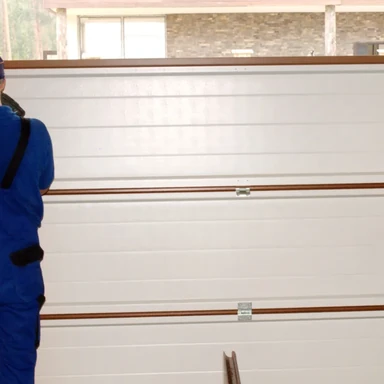
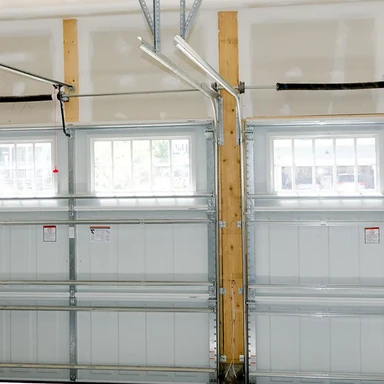
An insulated garage door is sold on a single number, and the number means less than the label suggests. R-value tells you how well a section of the door resists heat flow. It does not tell you how the installed door performs, and it says nothing about the garage it is fitted to.
The industry body DASMA publishes a technical sheet on exactly this point. R-value is calculated for the door section alone, based on the material and its thickness. The thermal performance of a complete installed door is measured as a U-factor, in a chamber test of the whole assembly, including the joints, the stiles, the thermal breaks and the weather seals.
DASMA states plainly that the two methods are not comparable and that, for garage doors, U-factor and R-value are not reciprocals of each other. That is worth reading twice. The R-value on a spec sheet is a property of a panel in a lab. The door in your opening has gaps at the perimeter, joints between sections and a bottom seal that may or may not be touching the floor.
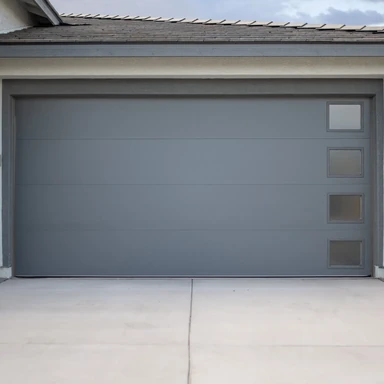
Garaga's construction range is a fair map of the market. A two-layer door with one steel skin and polystyrene backing is rated R-7.2. A three-layer door with two steel skins and polystyrene is rated R-7 to R-15.1 depending on thickness. A three-layer door with injected polyurethane is rated R-12 or R-16.
Two things follow. Polyurethane delivers more resistance per inch than polystyrene, which is why it is used where the section has to stay thin. And the jump from R-7 to R-16 is not a jump from cold to warm, because the section is only one part of the envelope.
In a Fairfax County house where the garage shares a wall with the kitchen or sits under a bedroom, the garage is a buffer. It is not heated, but it is not outdoors either. Insulating the door does four things in that space.
It slows heat loss through the largest single opening in the house's envelope. It reduces condensation, because a surface that stays closer to indoor temperature does not collect as much moisture, and the garage slab, the tools and the stored paint stop sweating through a January thaw. It makes the garage quieter, because the foam absorbs sound. And it makes the space usable for longer at both ends of the year, which matters in a county where the garage is often the gym, the workshop or the overflow storage.
The condensation point is the one most often missed. A cold steel door in an unheated garage is a condensing surface, and the freeze-thaw cycle here drives that hard: warm moist air, then a cold night, then water on every cold surface by morning. Insulation does not eliminate it, but it moves the dew point.
It does not make the garage a conditioned room. If the walls and ceiling above are uninsulated, which is normal for a 1960s rambler and common in newer townhouses where only the shared wall is insulated, the door is one surface among several and the arithmetic does not close.
It does not fix air leakage. Most of the draft in a garage comes around the perimeter rather than through the panel: the bottom seal, the sides, the top. A perimeter seal kit and a properly adjusted bottom seal will do more for a cold, drafty garage than an extra R-4 in the panel.
It does not pay on a detached garage. A detached garage with no heat and no living space above is a shed with a door on it, and a single-skin door is the rational purchase.
Three questions. Is the garage attached to the house? Is any living space above it, beside it or over it? Is the garage used for something other than parking, such as a workshop, a gym or storage of things that dislike damp?
Two yes answers put you in the insulated camp, and a three-layer door with polyurethane is the honest specification. One yes answer makes a two-layer polystyrene door a reasonable compromise. No yes answers means the R-value is decoration.
Angi prices an insulated door at $1,100 to $4,200 against a standard door, noting that the premium buys comfort and lower energy use rather than a fast payback. Fixr puts installing an insulated door at $700 to $2,300.
The gap between those two bands is glazing, section thickness and size. A double door with windows and polyurethane sits at the top of both. A single door without glazing sits at the bottom.
Ask for the R-value and then ask what it was measured on. Ask for the section thickness. Ask whether the door has a thermal break between the skins, because a steel skin that touches through the section is a thermal shortcut that no amount of foam fixes. Ask what the perimeter seal includes and whether the bottom seal is adjustable.
If a seller quotes an R-value with no model number, no thickness and no mention of the seals, the number is marketing.
Fairfax Garage Doors is a matching service. We do not install doors. We take the opening, the garage layout and how you use the space, and licensed local companies quote the door and the fitting. The contract and the warranty are between you and the company you choose.
For an attached garage with living space above or beside it, a three-layer door in the R-12 to R-16 range is sensible. For a detached unheated garage, insulation is optional.
No. It slows heat loss and reduces condensation. The garage stays unconditioned unless the walls and ceiling are insulated too.
R-value is calculated for the door section alone. U-factor is measured on a complete installed assembly including joints and seals. DASMA notes the two are not reciprocals for garage doors.
Published ranges put an insulated door at $1,100 to $4,200, or $700 to $2,300 for the installation, depending on size and glazing.
A replacement door is measured, not guessed. In Fairfax the opening, the headroom and the HOA rule all decide what fits.
Most garage door calls are one worn part, not a worn out door. The trick is knowing which part.
A spring is a wear part with a number on it. Ten thousand cycles, then it breaks.
An opener does not lift the door. It steers a door that the springs already balanced.
A dented section is a part. Three dented sections and a rusted bottom rail is a decision.
A commercial door is judged on cycles per day, not on how it looks from the street.
Garage Doors in Fairfax, VA - costs, water and soil notes.
Garage Doors in Vienna, VA - costs, water and soil notes.
Garage Doors in Oakton, VA - costs, water and soil notes.
Garage Doors in Burke, VA - costs, water and soil notes.
Garage Doors in Annandale, VA - costs, water and soil notes.
Garage Doors in Springfield, VA - costs, water and soil notes.
Garage Doors in Falls Church, VA - costs, water and soil notes.
Garage Doors in Herndon, VA - costs, water and soil notes.
Garage Doors in Reston, VA - costs, water and soil notes.
Garage Doors in Chantilly, VA - costs, water and soil notes.
Garage Doors in Centreville, VA - costs, water and soil notes.
Garage Doors in McLean, VA - costs, water and soil notes.