The material debate on garage doors is usually framed as looks against durability. In Fairfax County the question is narrower: which material survives a humid summer and a freeze-thaw winter, and which one fails in a way you can see coming.
Angi's 2026 material table prices a steel door at $650 to $3,200, aluminum at $600 to $2,900, and wood at $900 to $4,500. Composite or false-wood doors sit at $650 to $4,800.
The overlap is wide because the material is only the start. Gauge, insulation, section thickness and glazing move a steel door across most of that band on their own. A thin single-skin door and a heavy insulated one are both called steel.
Modern doors use galvanized sheet with a baked-on finish, and a sound painted panel will not rust. The failures start where the coating is broken or where water sits. Three places account for most of it: the bottom section where it meets the seal, the cut edges at the ends of each section, and the interior face of the bottom panel, which never gets sun and never dries.
Fixr notes that rust on a steel door often begins inside the core and works outward, which is why a door can look sound until a bubble appears and then crumbles when you press it. Once the bottom section has gone, the door is usually a replacement rather than a repair, because color and profile matching to an old model is unreliable.
In this climate the mechanism is simple. Summer humidity puts moisture in the air, and the slab wicks ground moisture. The bottom seal traps both against bare steel for months. Then winter salt from the beltway and the primary roads is carried in on the tires and sprayed onto the same area. Steel is the cheapest way to a good-looking door, and the most dependent on a dry bottom edge.
Steel repair work is published at $250 to $700.
Aluminum does not rust in the way steel does, because the oxide that forms on the surface seals it. That makes it sensible for a door that faces the weather with no shelter, and it is why aluminum doors are common on townhouse garages set flush to the facade.
What aluminum does instead is dent. A light aluminum panel takes a basketball or a bin lid and keeps the mark. It also corrodes at fixings and at the frame where salt meets bare metal, showing as a white bloom rather than red rust. A thin aluminum door is also noisier in service, because it has less mass to absorb the movement.
The trade is real: lighter panels mean lighter springs, which means springs and opener wear more slowly. Aluminum repair is published at $200 to $600.
Wood moves. In a Fairfax County summer the panels take on moisture and swell; in a dry January they shrink back. Paint is the only thing standing between the wood and that cycle, and every coat that cracks at a joint lets water into the end grain. The bottom rail is where it starts, because it sits closest to splash and snow melt, and once the rail is soft the door is holding its shape out of habit.
A wood door can last decades here, but it will need repainting on a cycle and it will need the bottom rail watched. On the county's older brick ramblers a painted wood door is often original, and the honest advice on a forty-year-old door with a soft rail and peeling paint at the joints is usually replacement rather than another coat.
Wood repair is published at $250 to $1,000, the widest band of the three, because rot repair is carpentry rather than parts swapping.
Steel goes at the bottom section interior, the hinges and the roller bearings. Aluminum goes at the dents first, then the fixings. Wood goes at the bottom rail, then the joints.
That order tells you what to inspect. Looking at the middle of a door tells you almost nothing. Kneel down and look at the bottom section from inside the garage with a flashlight, and run a screwdriver handle along the bottom rail. Those two checks find most of the problems before they cost a door.
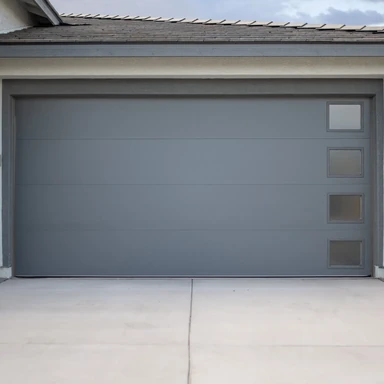
For a townhouse with a door set flush into the facade, a steel door with a well-sealed bottom and a galvanized bottom section is the value choice, and aluminum is reasonable where dents are unlikely. For a rambler with a deep eaves overhang and a shaded driveway, steel will outlast most owners' patience provided the bottom edge drains.
Where the door is part of the elevation and the community has a palette to match, wood or a good composite buys the look, at the cost of a repainting cycle. Either way, ask what the bottom section is made of. That one detail predicts more about the door's life here than the material name on the brochure.
Fairfax Garage Doors is a matching service. We do not install or manufacture doors. We collect the opening size and the look you want, put the job to licensed local companies, and you hold the contract and the warranty with the one you choose.
A sound painted steel door does not rust on the face. It fails at the bottom section, at cut edges and on the interior face where moisture and road salt sit against bare metal.
Aluminum does not rust and is lighter, which is easier on springs and the opener. It dents more easily and can corrode at fixings in salt. Steel is stronger for the money.
It depends on exposure and on how the door was finished, but expect a repainting cycle rather than a once-only job. Watch the bottom rail and the joints first.
Published 2026 ranges are $650 to $3,200 for steel, $600 to $2,900 for aluminum and $900 to $4,500 for wood, with wide overlap depending on gauge, insulation and glazing.
A replacement door is measured, not guessed. In Fairfax the opening, the headroom and the HOA rule all decide what fits.
Most garage door calls are one worn part, not a worn out door. The trick is knowing which part.
A spring is a wear part with a number on it. Ten thousand cycles, then it breaks.
An opener does not lift the door. It steers a door that the springs already balanced.
A dented section is a part. Three dented sections and a rusted bottom rail is a decision.
A commercial door is judged on cycles per day, not on how it looks from the street.
Garage Doors in Fairfax, VA - costs, water and soil notes.
Garage Doors in Vienna, VA - costs, water and soil notes.
Garage Doors in Oakton, VA - costs, water and soil notes.
Garage Doors in Burke, VA - costs, water and soil notes.
Garage Doors in Annandale, VA - costs, water and soil notes.
Garage Doors in Springfield, VA - costs, water and soil notes.
Garage Doors in Falls Church, VA - costs, water and soil notes.
Garage Doors in Herndon, VA - costs, water and soil notes.
Garage Doors in Reston, VA - costs, water and soil notes.
Garage Doors in Chantilly, VA - costs, water and soil notes.
Garage Doors in Centreville, VA - costs, water and soil notes.
Garage Doors in McLean, VA - costs, water and soil notes.