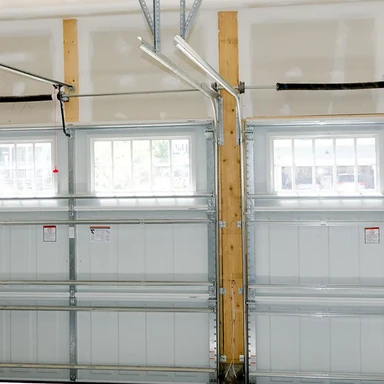
A torsion spring is the part of the door that does the lifting. The opener only starts and steers the movement. When a spring breaks, the door becomes a dead weight of a hundred and fifty to four hundred pounds, and the repair is one of the few jobs on a house where a mistake is genuinely dangerous.
Most doors here carry two torsion springs on a steel shaft above the opening. Each one is wound under tension at installation, and together they counterbalance the door so a person can lift it with one hand.
That is why a broken spring does not simply make the door stiff. It removes about half the lifting force, and the opener then tries to haul the full weight through a mechanism designed to move it, not carry it. Openers burn out quickly under that load.
Springs are rated in cycles rather than years. A household that opens the door four times a day wears out a builder-grade spring well before one that leaves the car outside all week.
Climate adds to it. Fairfax County runs through repeated freeze-thaw from December into March, and an unheated garage swings with the outside air. Moisture condenses on cold steel overnight, sits in the coil, and the wire pits. Salt carried in on the beltway and the primary roads makes that worse, because the same film that eats a car's rocker panel settles on the coil and the bottom section.
The third factor is the door itself. A heavy wood door or an insulated door with glass needs a heavier spring wound tighter, and a stiffer bottom seal that has gone hard in the cold adds load at exactly the point where the spring is most extended. On a north-facing garage that never dries out, a spring that should give eight years often gives five.
A torsion spring usually gives warning. The door gets heavier to lift by hand. It stops holding position halfway open and drifts down. The opener strains at the start of the lift and the light dims when it does. There is a gap in the coil, or a visible kink, or rust bleeding from between the coils.
Then it breaks with a sound like a gunshot. The door may drop a few inches and hang. Do not cycle it again to test it. A door with one broken spring of a pair is being held by a spring that has just taken on double load.
The springs come as a matched pair, both replaced, even when only one has broken. The new springs are sized to the door's actual weight, not to the size of the old spring, because a door that has been painted, re-glazed or fitted with a new bottom seal is not the door the original spring was chosen for.
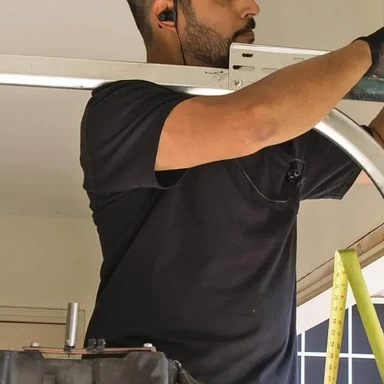
The technician checks the wire size, the inside diameter and the wind count against the door weight, winds with proper winding bars, and then does a balance test: the door should hold itself at waist height, open and close without the opener attached, and need roughly the same effort to lift as to lower. Bearings and the center bracket are inspected while the shaft is bare, because a worn bearing will eat a new spring. A dry lubricant goes on the coils, the hinges and the rollers.
Ask for the cycle rating in writing. A spring rated for a higher number of cycles costs more and lasts longer, and it is the one specification in the job that determines how soon you are doing this again.
Angi publishes a range of $150 to $350 for a spring replacement, with a national average of $250 and local labor rates on top. Within that, a torsion spring is listed at $75 to $150 each and an extension spring at $50 to $100. Fixr puts torsion spring replacement at $200 to $350 and all spring work at $120 to $350. ConsumerAffairs reports $160 to $350 for a typical job, with labor of $75 to $150 inside it.
Converting a door from extension springs to torsion, which is worth doing on an older door with the tracks already off, is quoted at $400 to $800. A single spring swapped on its own is the cheap version of this job and the one that brings a second call within a season.
One spring replaced on a two-spring door. A quote with no cycle rating. A technician who winds the spring without checking the door weight first. A price at half the others with no balance test, which is the part that proves the spring was sized right.
And do not accept a DIY plan from anyone, including a helpful neighbor with a set of winding bars. The stored energy in a wound torsion spring is enough to break an arm, and the failure is silent until it is not.
Fairfax Garage Doors is a matching service, not an installer. We pass your door type, spring configuration and address to licensed local companies and bring back quotes, and you contract directly with the company you choose. On spring work it is worth asking each one what cycle rating they are quoting and whether both springs are in the price, because that is where the quotes will differ.
Published ranges put it at $150 to $350 per spring including labor, averaging about $250. Torsion springs are the more expensive type at roughly $75 to $150 each in parts.
Yes. Paired springs wear at the same rate, and the surviving spring is carrying double load. Replacing one usually leads to a second call within months.
No. The door is far heavier than the opener is designed to lift, and it can drop. Leave it closed and call for service.
Springs are rated in cycles, not years. Use, door weight, and the moisture and salt a garage sees all shorten life, so two identical doors on the same street can differ by several years.
A replacement door is measured, not guessed. In Fairfax the opening, the headroom and the HOA rule all decide what fits.
Most garage door calls are one worn part, not a worn out door. The trick is knowing which part.
A spring is a wear part with a number on it. Ten thousand cycles, then it breaks.
An opener does not lift the door. It steers a door that the springs already balanced.
A dented section is a part. Three dented sections and a rusted bottom rail is a decision.
A commercial door is judged on cycles per day, not on how it looks from the street.
Garage Doors in Fairfax, VA - costs, water and soil notes.
Garage Doors in Vienna, VA - costs, water and soil notes.
Garage Doors in Oakton, VA - costs, water and soil notes.
Garage Doors in Burke, VA - costs, water and soil notes.
Garage Doors in Annandale, VA - costs, water and soil notes.
Garage Doors in Springfield, VA - costs, water and soil notes.
Garage Doors in Falls Church, VA - costs, water and soil notes.
Garage Doors in Herndon, VA - costs, water and soil notes.
Garage Doors in Reston, VA - costs, water and soil notes.
Garage Doors in Chantilly, VA - costs, water and soil notes.
Garage Doors in Centreville, VA - costs, water and soil notes.
Garage Doors in McLean, VA - costs, water and soil notes.