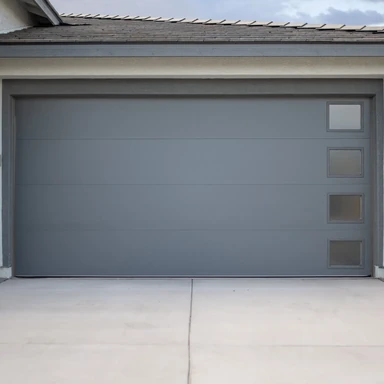
A crooked door is a door being held up unevenly. The gap at one corner is the symptom, not the fault.
A door leaves its track when one side stops carrying its share of the weight. Sometimes that is a car bumper in a tight townhouse driveway. More often it is a cable that came off its drum, a roller whose stem snapped, or a track that was never anchored into sound framing. The door then hangs at an angle, and the opener keeps pushing it.
Four causes cover most of the calls. A vehicle or a ladder clips a bottom corner and bends the vertical track. A lift cable jumps its drum or snaps, so one side of the door drops. A torsion spring breaks and the door comes down hard on one side. A roller breaks or wears through and the door rides out of the channel at that point.
Debris does it too. A bag of salt, a bike, a snow shovel or a stack of storage bins leaning on a vertical track is enough to push the door out at a bottom corner, and a garage used as storage is where a lot of those calls start.
Older Fairfax County stock adds a fifth. On a 1950s or 1960s brick rambler the garage was often framed with a thin header and the tracks were anchored with masonry nails into whatever was behind them. Sixty years of freeze-thaw later, the anchor is loose and the track has drifted out of plumb. The door did not fail that day. The wall did, slowly.
Any of these means the door is running on geometry it was not built for. The panels are the weakest part of the assembly, and a door driven while crooked will crack a section at the hinge line or tear the bottom bracket out of the panel.
Stop using the door. Do not force it back onto the track by hand, and do not cut a cable to release the tension, because the cable is often the only thing holding the door up. A door that is stuck open leaves the house unsecured, which is the case for an emergency call rather than a wait until Monday. F & B Garage Door publishes an after-hours surcharge of $75 to $150 for that, disclosed before dispatch.
If the door is stuck open and the weather is coming in, do not stand under it to close it. Tie nothing to the bottom bracket. Lock the door between the garage and the house, take anything valuable out of the bay, and wait for a technician.
The technician checks the track for plumb and for bent sections, the drums for cable build-up, the rollers, and the panel edges at every hinge. A simple derailment on straight track is a reset and a roller check. A door that came off because a cable or spring failed is a different job, and the cause gets fixed before the door is put back. Rollers are usually replaced as a set on a door that has jumped, because the one that came out is rarely the only worn one.
GarageWiz lists an off-track reset across the region at $250 to $700, rising with bent track and bent panels. Where a section has cracked, a single panel is published at $400 to $1,200 by GarageWiz and $500 to $1,200 by Quality Garage Doors VA, which is the honest range for a matched panel on a 1990s townhouse door.
A track that is kinked in the curved radius section is replaced, not straightened. Straightening a radius is how a door keeps jumping the same corner.
No. A door that is off the track is often being held by one cable under load, and pushing it can drop it on you or bend a panel. Stop using it and call.
A minor kink in a straight run can sometimes be straightened. A kink in the curved radius section is replaced, because that curve is what guides the door from vertical to horizontal.
Damage from a vehicle impact is often covered under the auto or home policy. Ask your insurer before you approve the repair, and keep the written quote.