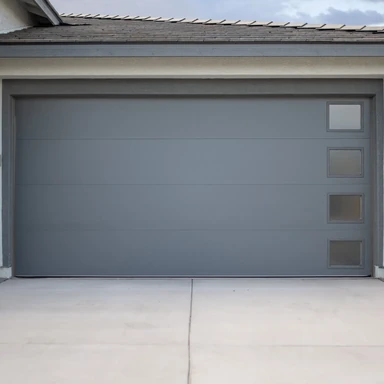
Sag is a weight problem. The door has stopped being balanced, and the opener is covering for it.
A garage door is supposed to weigh almost nothing in your hand. Springs are sized to the door's weight and take it across the whole travel, so a balanced door stays where you leave it, halfway up or halfway down. When that balance goes, the door sags at a corner, drags on the way up, or needs two hands to lift. All three are the same fault at different stages.
The common cause is a spring that has lost tension rather than broken. A torsion spring can lose a turn or crack partway and still hold the door up, badly. On a two-spring door, one tired spring pulls the door crooked, which is why the sag usually shows at one top corner.
Other causes are a cable that has stretched or jumped a drum, a track that has dropped out of plumb, and a door that was never rebalanced after a spring swap. On the older brick ramblers around the City of Fairfax, a header that has settled over sixty years shows up as a door that sags in the middle while the tracks are perfectly straight.
Wood doors add their own version. A wood panel door takes on moisture through the summer, gains weight, and drags until October. That is not imagination. It is a door that was balanced dry and is now heavier than its springs were sized for.
Close the door fully. Pull the release cord once, with the door down, so the opener is disconnected. Lift the door by the handle to about waist height and let go. A balanced door stays where you put it, or drifts slowly. A door that drops has lost its spring. A door that needs real effort to lift has lost most of it.
Stand to the side, not under the door, and keep hands away from the hinges and the track. If the door runs away from you, let it go and step back. Do not try to catch it. When the test is finished, reconnect the trolley by running the opener until it latches, or leave it disconnected until the technician arrives.
A door that moves but moves slowly is usually fighting something. A binding track, a dry roller, a door that is heavier than the opener's force setting expects, or an opener with a failing capacitor or a tired motor. Cold makes all of it worse, because grease thickens and a tired spring lifts less. A door that crawls for the first foot and then speeds up is usually dragging on a flattened seal or a slab that has heaved at the opening, which is common on older driveways here after a hard winter.
The wrong fix is to turn the force adjustment up. That setting exists to stop the door on an obstruction, and raising it until the door moves defeats the reversal that protects a child under the door. If the door needs more force to move, something is wrong with the door, not with the setting.
The technician weighs the door, checks the spring wire and inside diameter against that weight, and checks the drums and cables. Springs are replaced as a pair and wound to the door's specified turns. Then the door is balanced again, the track is plumbed, and the opener force and travel are reset from scratch.
Spring pricing published locally runs $250 to $800 at GarageWiz and $300 to $750 at Quality Garage Doors VA, with high-cycle springs at the top of the range. Quality Garage Doors VA puts spring life at 7 to 12 years, or 10,000 to 15,000 cycles. Ask what rating the replacement carries, because a 10,000-cycle spring and a 25,000-cycle spring look the same on an invoice and are not the same part.
If the sag turns out to be the header or the framing, that is a carpentry job, not a door job. Ask who is doing that part before the door is ordered.
No. The force setting is what makes the door reverse on an obstruction. Raising it to cover a heavy door disables the safety reversal and wears the opener out faster.
Quality Garage Doors VA puts spring life at 7 to 12 years, or 10,000 to 15,000 cycles. A door that runs four or five times a day reaches the bottom of that range first.
No. A door that hangs unevenly loads one cable and one track, and it can come down. Use it as little as possible until it is checked.